
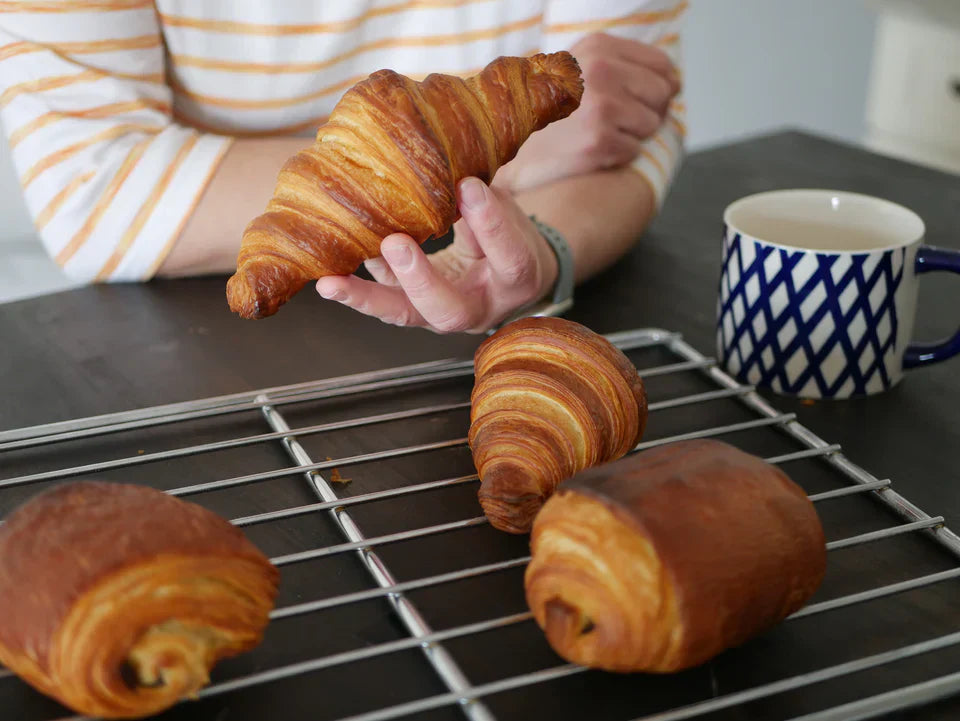
Sourdough croissants are genuinely different from classic croissants — subtly tangier, slightly chewier inside, and more complex in flavour — but not categorically better. Whether they're worth it depends entirely on what you want from the pastry. Here's an honest breakdown.
If you've been anywhere near a serious bakery or a baking-focused corner of the internet in the last year, you've seen them. Sourdough croissants — darker, more complex, slightly tangy versions of the laminated pastry everyone already loves — have become one of the fastest-growing baking searches in 2026. Every artisan bakery with an Instagram account seems to have one on the menu. The question worth asking is whether this is a genuine upgrade or just a trend with good PR.
The answer is: genuinely both, and it depends on what you value in a croissant.
What a Regular Croissant Is (and Isn't)
A classic French croissant is a laminated dough — flour, water, milk, butter, sugar, salt, and commercial yeast, folded repeatedly with a large slab of butter to create hundreds of paper-thin alternating layers of dough and fat. The layering (called lamination) is what makes the croissant flaky. When you bake it, steam from the butter causes the layers to separate and puff, creating that distinctive honeycomb interior.
Commercial yeast is what drives the rise. It's fast-acting, predictable, and does one job well: produce CO2 to inflate the dough. It doesn't contribute much flavour, which is why the flavour of a great croissant comes almost entirely from the quality of the butter and the skill of the lamination.
This is actually fine. A well-made croissant with high-quality butter doesn't need complex fermentation flavour — it already has enough going on. The butter is the star.
What Makes Sourdough Croissants Different From Classic
Replace the commercial yeast with a sourdough starter and a few things shift.
First, the leavening becomes slower and less predictable. Sourdough leavening requires much longer fermentation times — often 24 hours or more for the initial dough before lamination even begins. This is already a technically demanding pastry; adding wild yeast timing to the equation raises the difficulty considerably. Most bakeries that make sourdough croissants consistently have bakers who do essentially nothing else.
Second, the lactic acid bacteria in the starter add organic acids to the dough during fermentation. This creates a subtle but noticeable tang in the finished croissant — mild enough not to clash with the butter, complex enough to add a layer of flavour that a conventional croissant doesn't have. It's not sour the way sourdough bread is sour. It's more like the faint tang you'd find in a high-quality cultured butter — a background note that makes the whole thing taste more considered.
Third, the extended fermentation does to the croissant dough what it does to bread dough: partial gluten modification, reduced phytic acid, and a different texture in the finished crumb. (We go deep on exactly how fermentation changes bread if you want the full science.) Sourdough croissants often have a slightly chewier, more substantial interior than commercial-yeast croissants, which some people prefer and some don't.
| Sourdough Croissant | Classic Croissant | |
|---|---|---|
| Leavening | Wild yeast + lactic acid bacteria | Commercial yeast |
| Fermentation time | 24+ hours before lamination begins | 2–4 hours total |
| Flavour profile | Buttery with subtle, complex tang | Pure butteriness, no tang |
| Interior texture | Slightly chewier, more substantial | Feather-light |
| Time to make at home | 3–4 days (realistically) | 2 days |
| Phytic acid | Reduced during fermentation | Largely intact |
| Technical difficulty | Very high | High |
Are They Actually Better?
This depends entirely on what you want from a croissant.
If you want the classic experience — shattering crust, feather-light interior, pure butteriness — a great conventional croissant is hard to beat. The sourdough version introduces complexity that isn't always a straight improvement; it's a different croissant, not a categorically superior one.
If you want more depth — something that tastes like it was made with more intention, has a bit more chew, and lingers on the palate a few seconds longer — sourdough croissants deliver that. The tang is subtle enough that people who don't know they're eating one often can't place what's different, but they notice it's better than what they expected.
The best way to form an opinion is to try a well-made version of both on the same day. Most people find they have a clear preference once they do.
Why They're So Hard to Make at Home
Laminated dough is the most technically demanding thing in conventional pastry. Every stage requires precision: the butter needs to be at the right temperature and plasticity to laminate without breaking into pieces or melting into the dough. The folds need to be even. The resting times between folds matter. The proofing has to hit a specific window — under-proofed croissants don't achieve full oven spring, over-proofed ones collapse.
Now add wild yeast timing to that. A sourdough starter's activity varies with temperature, hydration, and the health of your culture. Unlike commercial yeast, which performs reliably within a predictable window, wild yeast takes longer and responds more to environmental variables. A croissant dough that's perfectly proofed at 20°C might be under-proofed at 17°C or over-proofed at 24°C.
Professional bakers who make sourdough croissants consistently have usually spent weeks or months dialling in their specific process. It's not an afternoon project. The people who manage it at home are typically experienced laminated dough bakers who add sourdough as the next technical challenge after mastering the basics.
This isn't to put anyone off trying. But going in with realistic expectations — that your first batch will probably be imperfect, that the learning curve is real, and that the result is genuinely rewarding once you get there — is more useful than pretending it's accessible to any home baker on a weekend whim.
The Honest Case for Buying Them Instead
There's a reason people go to bakeries. Laminated pastries are one of those things where the gap between a home attempt and a professional result is wider than almost any other category of baking. It's not about talent — it's about equipment (deck ovens, proofing chambers, butter that's specifically calibrated for lamination), practice, and the kind of consistent feedback loop that comes from making hundreds of batches.
A sourdough croissant from a serious baker who has made thousands of them will almost always be better than a home attempt made twice a year. That's not a criticism — it's just how skill-intensive this particular thing is.
At Atome — 29,000+ boxes shipped across Canada — our croissants and chocolate croissants are made by bakers who do this every day — properly laminated, properly fermented, baked to the point where the layers shatter properly, and then frozen at peak quality. From your freezer to your oven in under 20 minutes. The result isn't a compromise version of a croissant. It's what a croissant is supposed to taste like when you're not making it yourself.
The sourdough croissant trend is justified. The best version of it, though, doesn't require you to spend a weekend learning lamination from scratch. And if you're thinking about where to source quality Canadian-made pastry, our guide on finding genuine Canadian artisan food producers is worth a read.
Frequently Asked Questions
What does a sourdough croissant taste like compared to a regular one?
A sourdough croissant has a subtle tang in the background — mild enough not to clash with the butter, noticeable enough to add flavour complexity. The interior tends to be slightly chewier and the overall flavour more layered. It tastes like a croissant that was made with more time and attention, because it was.
How long does it take to make sourdough croissants from scratch?
Realistically, 3 to 4 days for a proper batch. Day 1: mix and ferment the dough. Day 2: laminate, fold, and refrigerate. Day 3: shape, proof, and bake. Adding sourdough to the equation requires additional fermentation time before lamination even starts, which pushes the total timeline well beyond a conventional croissant process.
Can you taste the difference between sourdough and regular croissants?
Most people can, though many can't identify what's different until told. The tang is subtle — more of a background note than a prominent sourness. Most people who try both versions side by side settle on a clear preference, though which way they go varies. The quality of execution matters more than which type of leavening was used.
How do you bake a frozen croissant at home to get good results?
Preheat your oven to 190–200°C (375–390°F). Place frozen croissants directly on a baking tray lined with parchment — no thawing needed. Bake for 16–20 minutes until deeply golden brown. The internal temperature should reach around 88°C. Let them rest for 5 minutes before eating — the interior is still setting as they cool.
Are sourdough croissants better for you than regular ones?
Marginally, in the same ways sourdough bread has advantages over regular bread — lower phytic acid, partially modified gluten, potentially different digestibility. But a croissant is still mostly butter and flour. The health comparison between a sourdough croissant and a conventional one is not the primary reason to choose one over the other.


Leave a comment
This site is protected by hCaptcha and the hCaptcha Privacy Policy and Terms of Service apply.