
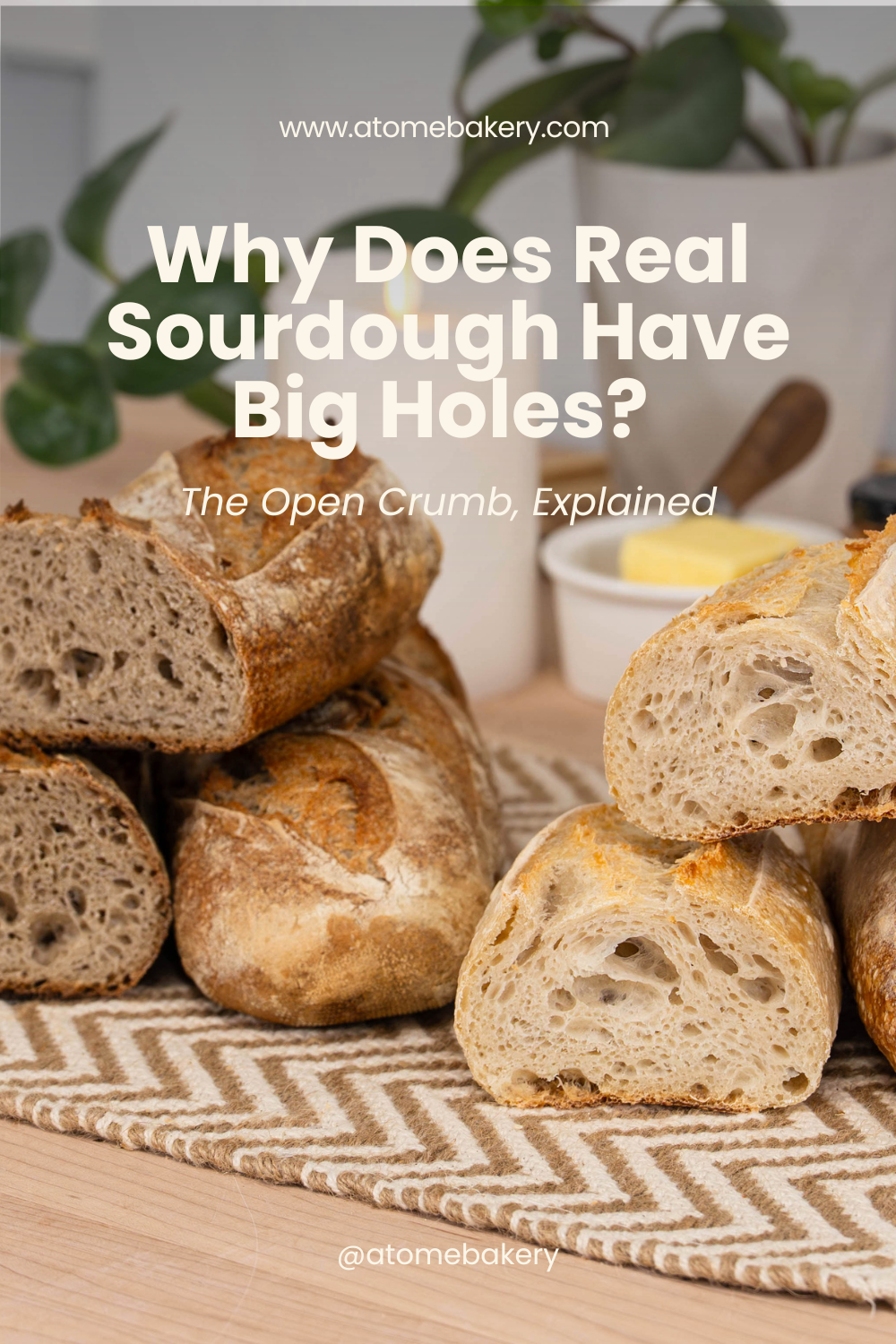
You cut into a fresh sourdough loaf, and the first slice reveals something that looks, honestly, kind of wild. Big uneven holes. Some the size of your thumbnail. Some small and scattered. The holes aren't tidy or uniform — they sprawl and cluster and then disappear entirely in certain spots. If you grew up on supermarket bread, your first instinct might be that something went wrong. It didn't. That's what real sourdough looks like, and the holes are telling you a specific story about how the bread was made.
This is called an open crumb, and it's one of the most visible markers of a properly made artisan sourdough. The uniform, even, small-bubbled crumb of commercial bread is actually the anomaly — the industrial standard got so normalised that most of us think it's what bread is supposed to look like. Open crumb is older, truer, and harder to achieve. Here's what's actually happening inside that loaf.
What an Open Crumb Actually Is
The crumb is the inside of a loaf — the textured interior, as opposed to the crust. An open crumb refers to a loose, irregular structure with larger and varied air pockets. A tight or closed crumb refers to a dense structure with small, uniform bubbles.
Neither is inherently better. Dense, tight crumb is what you want in a sandwich bread, a milk bread, or a pain de mie. You want slices that hold together, don't let your filling fall through, and give you a soft, even bite. Open crumb is what you want in an artisan country loaf, a rustic sourdough, or a baguette — breads where flavour complexity and textural contrast matter more than structural utility.
The confusion happens because supermarket sourdough is designed to have tight, uniform crumb — to look and behave like sandwich bread — while real artisan sourdough has open, irregular crumb. People see the open crumb for the first time and think it looks wrong. What they're actually seeing is an entirely different category of bread that happens to share a name.
The Science: How Those Holes Get There
Every hole in a loaf of bread started as a bubble of gas trapped in the dough. The dough expanded around the bubble as it fermented and rose. The baking set the structure in place. So every crumb pattern is really a frozen snapshot of what was happening in the dough the moment it went into the oven.
Commercial yeast, which supermarket bread uses, produces CO2 quickly and uniformly. The gas bubbles are small and evenly distributed because fermentation is fast and predictable. The dough rises uniformly and the final crumb reflects that — small, uniform, tight.
Sourdough fermentation, which uses wild yeast and lactic acid bacteria, is slower and more chaotic. The yeast populations aren't uniform. The bacteria are producing acids and other byproducts alongside the CO2. Fermentation happens over many hours, sometimes more than a day. During that time, gluten networks develop, stretch, and strengthen. Gas pockets coalesce — small bubbles merge into larger ones when the surrounding dough is elastic enough to support them.
The result is an irregular, varied crumb with larger air pockets. The dough structure is strong enough to hold those big pockets open because the long fermentation has built a resilient gluten network. On a commercial-yeast bread, the gluten hasn't developed the same way, so if you tried to produce the same irregular crumb, the structure would collapse.
Open crumb, in short, is mostly a byproduct of three things: long fermentation, well-hydrated dough, and gentle shaping that preserves gas pockets rather than punching them out. All three are hallmarks of artisan sourdough. All three are the opposite of how commercial bread is made.
Hydration: Why the Water Content Matters
Bakers talk about hydration to describe the ratio of water to flour in a dough. A 75% hydration dough has 75 grams of water for every 100 grams of flour. A white sandwich loaf is usually around 60–65% hydration. A proper rustic sourdough is often 75–85%. Some ciabatta doughs push 90% or higher.
Higher hydration dough is wetter, harder to handle, and capable of producing larger gas pockets because the wetter gluten stretches more elastically. This is why very open crumb is usually found in high-hydration breads. The dough can literally expand and hold bigger spaces before it tears.
This is also why tight-crumb sandwich bread is easier to make at home than open-crumb sourdough. Low-hydration dough is easier to shape, easier to slash, and more forgiving of timing errors. High-hydration sourdough is finicky. Professional bakers train for years on handling wet doughs because the skill transfer from one to the other isn't obvious.
Why Supermarket Sourdough Doesn't Have This Crumb
If you cut into a supermarket loaf labelled sourdough and compare the crumb to a real artisan sourdough, they look like different species. The supermarket version has uniform bubbles, soft and even texture, and no visible signs of the slow fermentation process. Real sourdough has uneven holes, visible fermentation stretch marks in the dough walls between the holes, and a substantial chew.
This happens because the supermarket version didn't undergo real fermentation. It used commercial yeast for speed. The dough was shaped by machines rather than hands. The gluten was developed quickly, and the gas distribution was optimised for consistency, which is what industrial packaging and slicing require. Uniform crumb fits through a slicing machine cleanly. Open crumb makes a mess of it.
So the crumb structure isn't just a visual thing. It's telling you whether the bread was made with time or without it, by hand or by machine, with live culture or with additives. Learning to read a crumb is a quick way to sort real sourdough from the things dressed up to look like it.
Is a More Open Crumb Always Better?
No. This is worth being direct about because the online sourdough community can be preoccupied with chasing extreme open crumb — big, dramatic holes, a structure that looks more like lace than bread. It's impressive, but it's not universally what you want.
A loaf with enormous holes is hard to butter. The butter falls through. Spreads slide around. Slices don't hold up well to heavier toppings. An aggressively open crumb is essentially optimised for dipping in olive oil or eating with soft cheeses — it's a specific use case, not a measure of quality.
A good artisan sourdough typically has a mix: some larger holes showing the fermentation, some smaller ones providing structural integrity, varied distribution rather than either extreme. That kind of crumb is versatile. It holds butter, supports a spread, works for sandwiches, toasts well, and still tells you immediately that it was made properly.
Chasing extreme open crumb is often a performance of technique rather than a pursuit of a better eating experience. The crumb that actually works for everyday meals falls somewhere in the middle.
What the Crumb Tells You About the Baker
You can learn quite a lot about a bakery by looking at the crumb of its bread.
An even, uniform, tight crumb in a supposedly artisan sourdough suggests shortcuts: commercial yeast, fast fermentation, machine handling. The fermentation either didn't happen or happened too quickly to develop structure.
A wildly open crumb with enormous holes in a small loaf often signals over-fermented dough or a dough that was too wet for its handling — the structure started to collapse.
A varied, irregular, medium-open crumb with visible fermentation gluten strands between the holes is the goal. It tells you the bread was fermented long enough to develop character, hydrated enough to open up, handled gently enough to preserve the gas, and baked at the right moment.
This is also why bakers care so much about the crumb. It's not aesthetics for its own sake — it's evidence of the whole process that came before. You can't fake a good crumb. You have to earn it by doing the fermentation, shaping, and bake correctly.
Can You Get This Kind of Crumb Baking at Home?
Yes, if you're willing to commit to the process. A real home sourdough practice — maintaining a starter, managing fermentation times, learning to shape high-hydration dough — will eventually produce an open crumb. It takes months of iteration for most people. There are great resources out there (Ken Forkish's Flour Water Salt Yeast is a classic starting point), and it can be deeply satisfying.
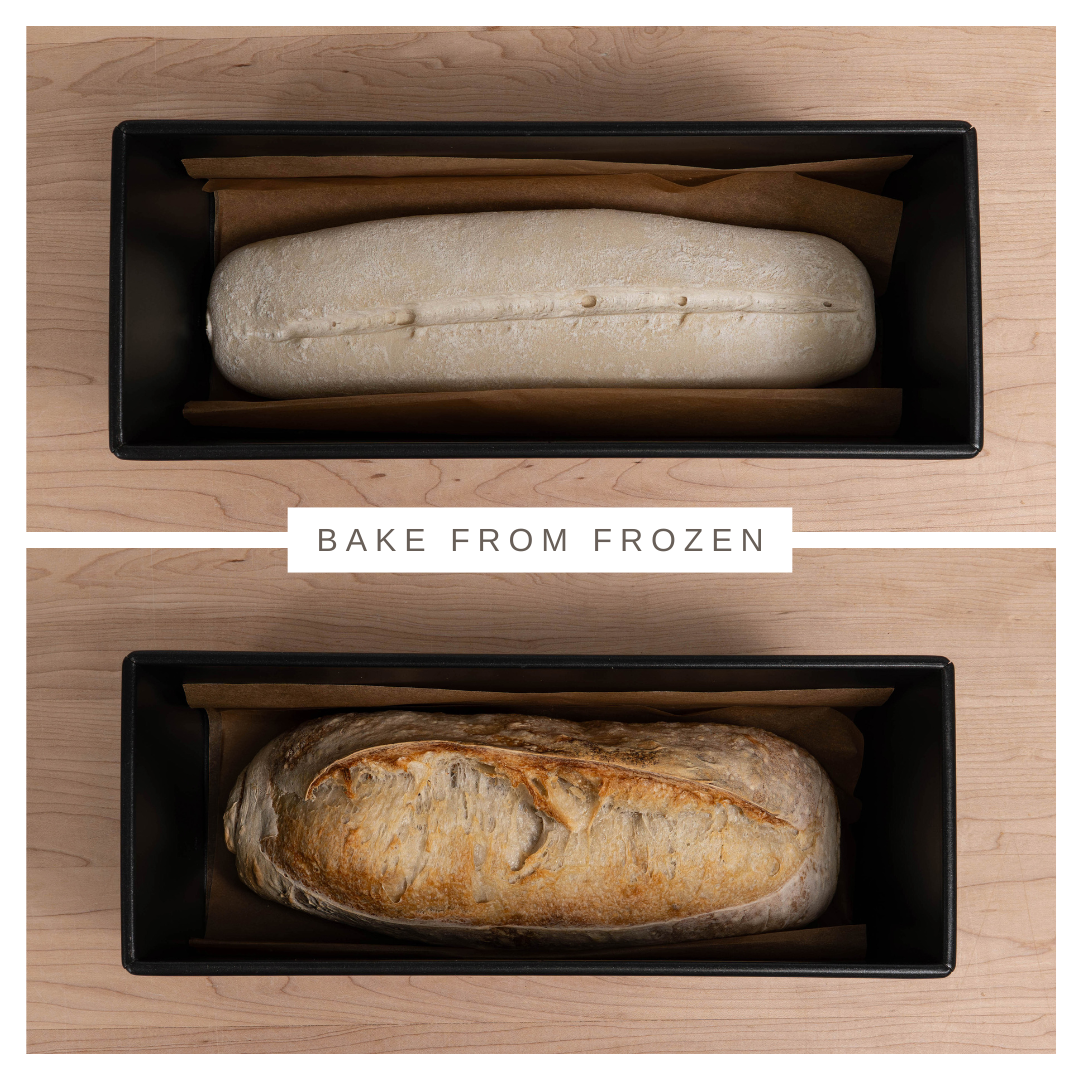
You can also skip ahead. At Atome Bakery, our sourdough is made with live starter culture, long fermentation, and hand shaping — the process that produces the open crumb described above. We bake the loaves fully, flash-freeze them at peak quality, and ship them frozen across Canada. When you bake one from frozen in your oven, you get the finished bread: proper crumb, proper crust, proper sourdough tang. The fermentation skill is ours. The warm loaf is yours.
If you've been staring at supermarket sourdough and wondering why it doesn't look like the loaves you see on social media, it's not your imagination. Those loaves are a different thing entirely. Now you know what to look for — and why it matters.
FAQ
Why does real sourdough have big holes?
The big, irregular holes (the open crumb) are a direct result of long fermentation with live sourdough starter. Wild yeast and bacteria produce gas slowly over 12 to 24 hours, during which time gluten networks develop and gas bubbles coalesce into larger pockets. Combined with higher-hydration dough and gentle shaping, this produces the uneven, open crumb associated with real artisan sourdough.
Is open crumb a sign of good sourdough?
Usually, yes. A varied, irregular open crumb indicates proper long fermentation, appropriate hydration, and careful shaping. It's visible evidence that the bread was made using real sourdough technique rather than commercial yeast shortcuts. That said, extremely open crumb isn't always better — an even, modestly open crumb with structural integrity is more useful for everyday eating than a loaf that's mostly air.
Why is my homemade sourdough crumb too dense?
Usually one of three reasons: the dough was under-fermented (didn't develop enough gas), the hydration was too low (gluten couldn't stretch enough to hold big pockets), or the shaping was too aggressive (punching out the gas before the final proof). Increase fermentation time, try a higher hydration dough, and shape more gently.
Can you tell if sourdough is real just by looking at the crumb?
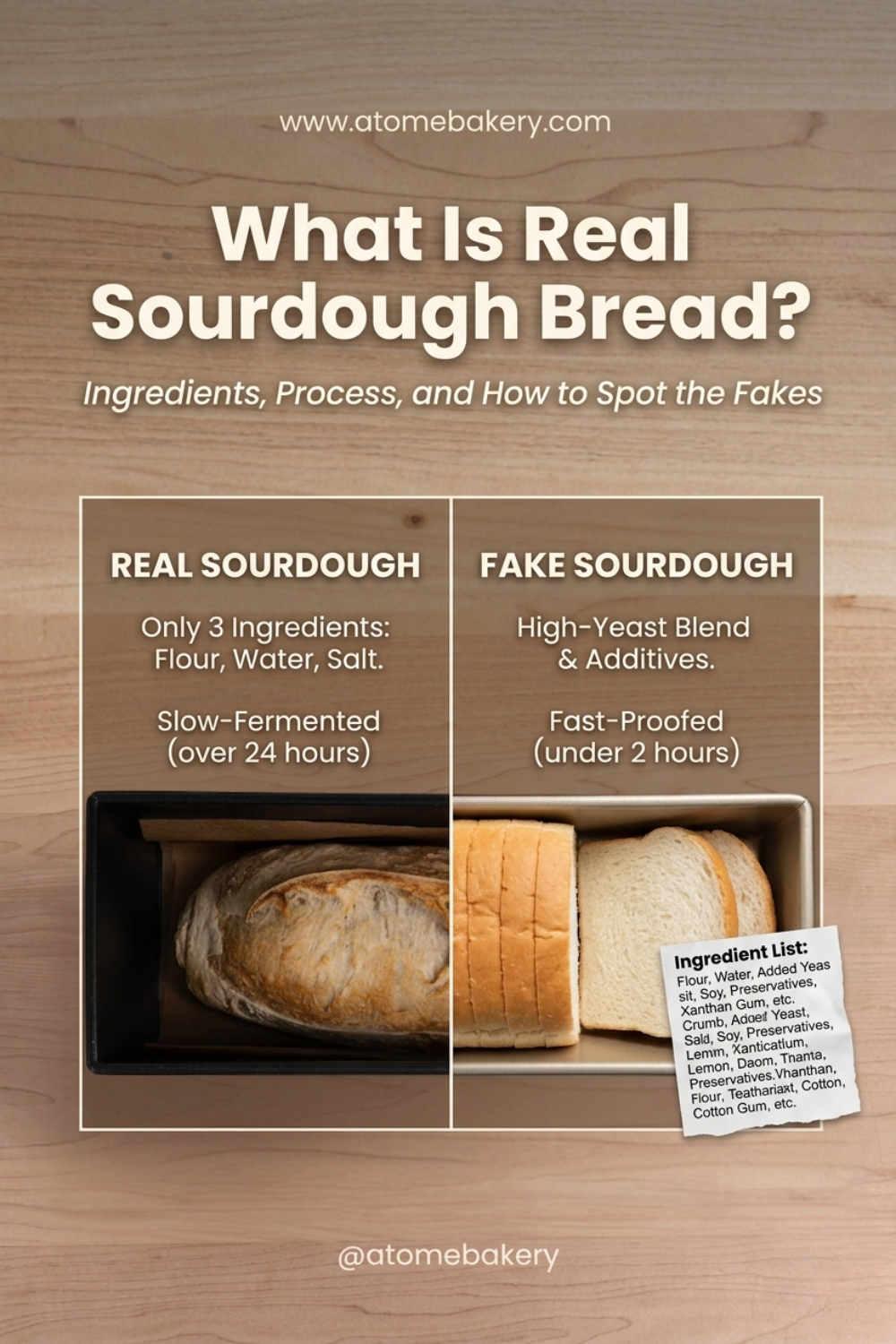
You can get most of the way there. A uniform, tight, small-bubbled crumb in a bread labelled sourdough is a strong indicator it was made with commercial yeast and fast fermentation. A varied, open, irregular crumb is a strong indicator of real sourdough. The ingredient list confirms it — real sourdough contains flour, water, salt, and starter; nothing else.
Does the crumb of sourdough change when you freeze the bread?
No. Once the loaf is baked, the crumb structure is set. Freezing preserves the bread's structure at the moment of freezing — the holes, the crumb pattern, everything. When you bake the bread from frozen, the crumb comes out exactly as it was when the bread was originally baked. The freezer doesn't change the bread; it pauses it.

Leave a comment
This site is protected by hCaptcha and the hCaptcha Privacy Policy and Terms of Service apply.