
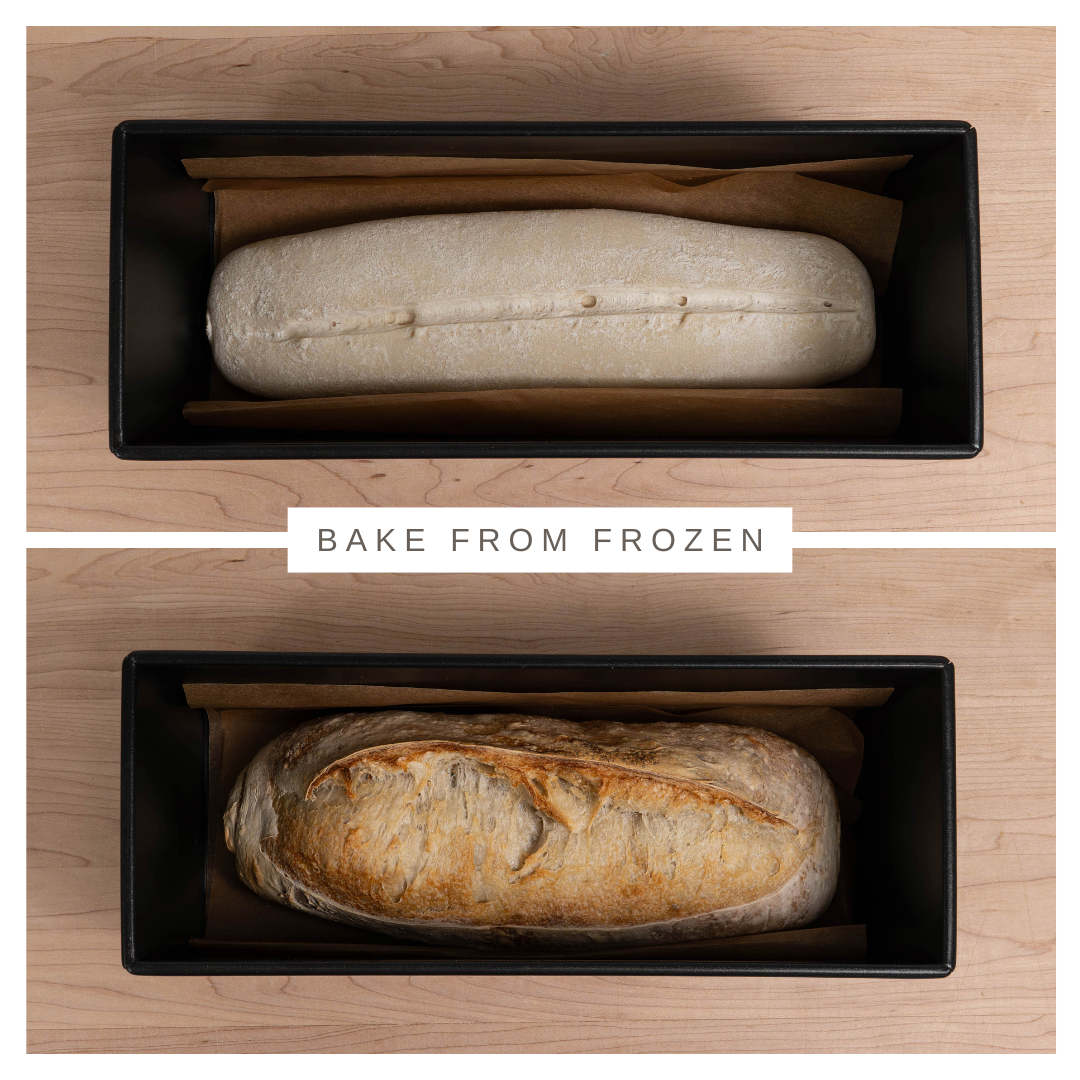
The oven takes longer to preheat than the bread takes to become a plan. You pull a frozen sourdough loaf out of the freezer, put it on a rack, set a timer for about half an hour, and that's essentially the whole recipe. Bread on demand. No thawing, no mixing, no proofing, no hoping the weather cooperates with your starter. And the result rivals anything you'd walk across town to buy fresh. Once you've done it a few times, baking sourdough from frozen starts to feel like a kitchen superpower you didn't know was available.
There are a few things worth knowing to get it consistently right, though — the kind of details that make the difference between great bread and merely decent bread. This is a working guide for how to bake sourdough bread from frozen at home, with the why behind each step so you can adapt when your oven or your loaf doesn't behave exactly like ours.
Why Baking from Frozen Actually Works
There's a specific category of frozen bread that works the way this guide describes: bread that was baked fully at the bakery, then flash-frozen at peak quality immediately after cooling. This is very different from parbaked bread (which was only partly baked before freezing and finishes baking in your oven), and different from thawing a loaf you froze yourself at home.
When a fully-baked loaf is flash-frozen, the structure, flavour, and moisture content get locked in place at the moment the bread left the oven. The starches, the crumb structure, the fermentation byproducts that give sourdough its character — none of it degrades the way it would at room temperature. The bread goes into stasis. When you bake it from frozen, the oven doesn't really re-bake the bread. It thaws the interior, crisps the crust, and releases the aromas that got sealed in during freezing. What comes out smells and tastes like it just came out of a bakery oven because it essentially did. The freezer just paused the clock.
This is why you skip thawing. Thawing first lets moisture redistribute and softens the crust before baking. You want the thermal shock — frozen loaf into hot oven — because that's what produces the best crust texture and prevents the crumb from going gummy.
What You Need Before You Start
The list is short, which is part of the appeal.
You need an oven that can reach 220°C (430°F) reliably. Almost every home oven can, but some older or smaller ovens struggle to hold temperature during a long preheat. If yours runs cool, give it extra time.
You need a flat surface for the bread to bake on. In rough order of preference:
The Atome Pan is designed specifically for baking our loaves from frozen. It gives you a consistent base temperature, holds the loaf's shape during oven spring, and transfers heat efficiently from underneath. If you have one, use it.
A baking steel or pizza stone works well too, preheated in the oven for at least 20 minutes before you load the bread. The thermal mass helps replicate a hearth oven's bottom heat.
A heavy baking tray or cast iron pan will work in a pinch, preheated similarly.
You also need oven mitts, a timer, and a clear space on the counter for the bread to rest when it comes out. That's the entire kit.
What you don't need: a thermometer probe, a spray bottle for steam, a Dutch oven, or a razor for scoring. The bread was scored and its steam handled before it was frozen. Your job is the final bake, and the bake is the easy part.
The Actual Process, Step by Step
Preheat your oven to 220°C (430°F). If you're using a stone, steel, or the Atome Pan, put it in during the preheat so it comes up to temperature with the oven. Give it a full 20 to 30 minutes after the oven signals it's ready — home oven thermostats often signal well before the air and surfaces are actually at temperature.
Take the loaf out of the freezer and remove any packaging. Don't let it sit around thawing. Straight from freezer to oven is the goal.
Place the frozen loaf directly onto the hot surface. If you're using a regular tray without preheating, place the loaf on the tray first and put the tray in the oven — but be prepared for a slightly softer crust on the bottom.
Close the oven door immediately. Every second it stays open, your oven loses heat and the initial thermal shock, which is what gives you beautiful oven spring and a crackling crust, weakens.
Set a timer for 25 minutes and walk away. For a standard sourdough loaf (around 500g), 25 to 35 minutes is the right range. Smaller loaves and baguettes bake faster (20 to 25 minutes). Very large loaves (700g+) can need closer to 40.
At the 25-minute mark, check the bread. If the crust is deeply golden and the loaf sounds hollow when you tap the bottom, it's done. If it looks pale or sounds dense, give it another 5 minutes and check again.
How to Tell When It's Done
The two reliable tests are colour and sound.
The crust should be deep golden brown, bordering on dark in places. A pale crust means the bread hasn't developed full flavour compounds — there's a specific chemistry (the Maillard reaction, plus caramelisation of the crust sugars) that only happens at higher temperatures, and that's where a lot of sourdough's finished flavour comes from. Don't be afraid of a dark crust. The darker, the more flavour.
The sound test: tap the bottom of the loaf with your knuckle. A properly baked sourdough sounds hollow, almost like tapping a small drum. If it sounds dull or dense, the crumb is still too moist inside. Another five minutes in the oven will usually resolve it.
If you have a thermometer and you want certainty, the internal temperature of a finished sourdough loaf is between 96°C and 99°C (205–210°F). Insert the probe into the centre of the loaf from the bottom to avoid marking the crust.
Let It Cool (Seriously)
This is the hardest step, and it's the one most people skip. A fresh loaf coming out of the oven continues to cook internally for about 30 minutes after you take it out. The crumb is still setting. The moisture is redistributing. The starches are finishing their transformation.
If you cut into it immediately, you'll get a gummy, slightly wet crumb and the crust will soften from trapped steam. Wait at least 30 minutes. An hour is better. Transfer the loaf to a wire rack so air can circulate underneath — resting it on a board or countertop traps moisture and softens the bottom.
We know this is painful when the house smells like fresh bread. Bake another loaf if you can't wait.
Common Mistakes (And Easy Fixes)
The crust is too pale: your oven wasn't fully preheated, or the temperature was too low. Preheat longer next time, and don't be shy about pushing the temperature higher (230°C / 450°F) for the last five minutes to brown the crust.
The crumb is gummy or underdone: you cut into it too early, or the bake was a few minutes short. For next time, bake longer and cool longer.
The crust is too tough: the bread was overbaked, or the oven was too hot for too long. Next time, drop the temperature 10 degrees or pull the loaf a couple minutes earlier.
The bottom burned: your preheated surface was too close to the heat source, or the oven runs hot. Try baking on the middle rack instead of the lower rack, or reduce the temperature slightly.
The loaf didn't rise in the oven: oven spring happens when the frozen dough is shocked by high heat early in the bake. If your oven wasn't at temperature when the loaf went in, or you opened the door too often, you lost the spring. Next time, preheat longer, load fast, and don't peek.
Baking Other Frozen Artisan Products
The same principle applies across the range, with adjusted timings.
Baguettes bake similarly to small loaves — 20 to 25 minutes at 220°C. They finish faster because they're thinner. The crust should shatter when you tap it.
Croissants and pain au chocolat bake at 180°C (350°F) for about 15 to 18 minutes from frozen. These are laminated pastries, so the goal is a deep golden colour and visible flaking. They rise dramatically in the oven from frozen, which is part of the show. Don't use a higher temperature — laminated doughs burn before they finish cooking through.
Waffles are ready-to-eat. They just need reheating — 2 to 3 minutes in a toaster, or about 5 in a 180°C oven.
The general rule: thicker and denser items (loaves) need higher temperatures and longer bakes. Thinner and more delicate items (pastries) need lower temperatures and shorter bakes. When in doubt, follow the instructions that came with your specific product. Bakery-to-bakery variations exist for a reason.
Why This Is the Future of Home Bread
Baking good bread at home used to mean committing to the process — a starter, a schedule, a sense of timing developed over months. That's a beautiful thing, and people who do it get something real out of it. But it isn't for everyone, and it doesn't need to be. For most people, access to properly made bread when they want it is the actual goal, not the meditation practice of making it themselves.
At Atome Bakery, we bake sourdough the traditional way — live starter, long fermentation, proper technique — and then flash-freeze it so you can bake it at home in about half an hour. Every order ships across Canada with the Atome Pan, which is designed specifically to get you the best possible result from a standard home oven. The craft happens on our side. The short, rewarding part — pulling a beautiful, crackling loaf out of your own oven — is on yours.
FAQ
Do I need to thaw frozen sourdough before baking?
No, and you shouldn't. Thawing first lets moisture redistribute, softens the crust before baking, and gives you a worse result. Go straight from freezer to hot oven. The thermal shock is what produces the crackling crust and open crumb when the loaf bakes.
What temperature should I bake frozen sourdough at?
220°C (430°F) is the sweet spot for most sourdough loaves. This temperature gives you proper crust development through the Maillard reaction and caramelisation while cooking the interior through evenly. Some very dense or very large loaves benefit from a slightly lower temperature for a longer bake.
How long does it take to bake a frozen sourdough loaf?
A standard 500g loaf bakes in 25 to 35 minutes. Smaller loaves and baguettes finish in 20 to 25 minutes. Large country-style loaves (700g or more) can need up to 40. The visible signs of doneness — deep golden crust, hollow sound when tapped — are more reliable than any timer.
Why does my frozen bread come out gummy inside?
Almost always because it was cut too early. The crumb continues setting for about 30 minutes after the loaf leaves the oven. Resting on a wire rack for at least half an hour solves it. If the bread is still gummy after a proper cool, it was likely underbaked and should have gone longer in the oven next time.
Can I use a regular oven, or do I need special equipment?
A regular home oven works perfectly. The one piece of optional equipment that genuinely helps is something with thermal mass — a baking stone, baking steel, or the Atome Pan — because it gives you consistent bottom heat that replicates a professional bakery oven. You can bake a great loaf without one, but preheating a thermal surface is the single biggest upgrade most home bakers can make.


Leave a comment
This site is protected by hCaptcha and the hCaptcha Privacy Policy and Terms of Service apply.